What Do Investors Want Today?
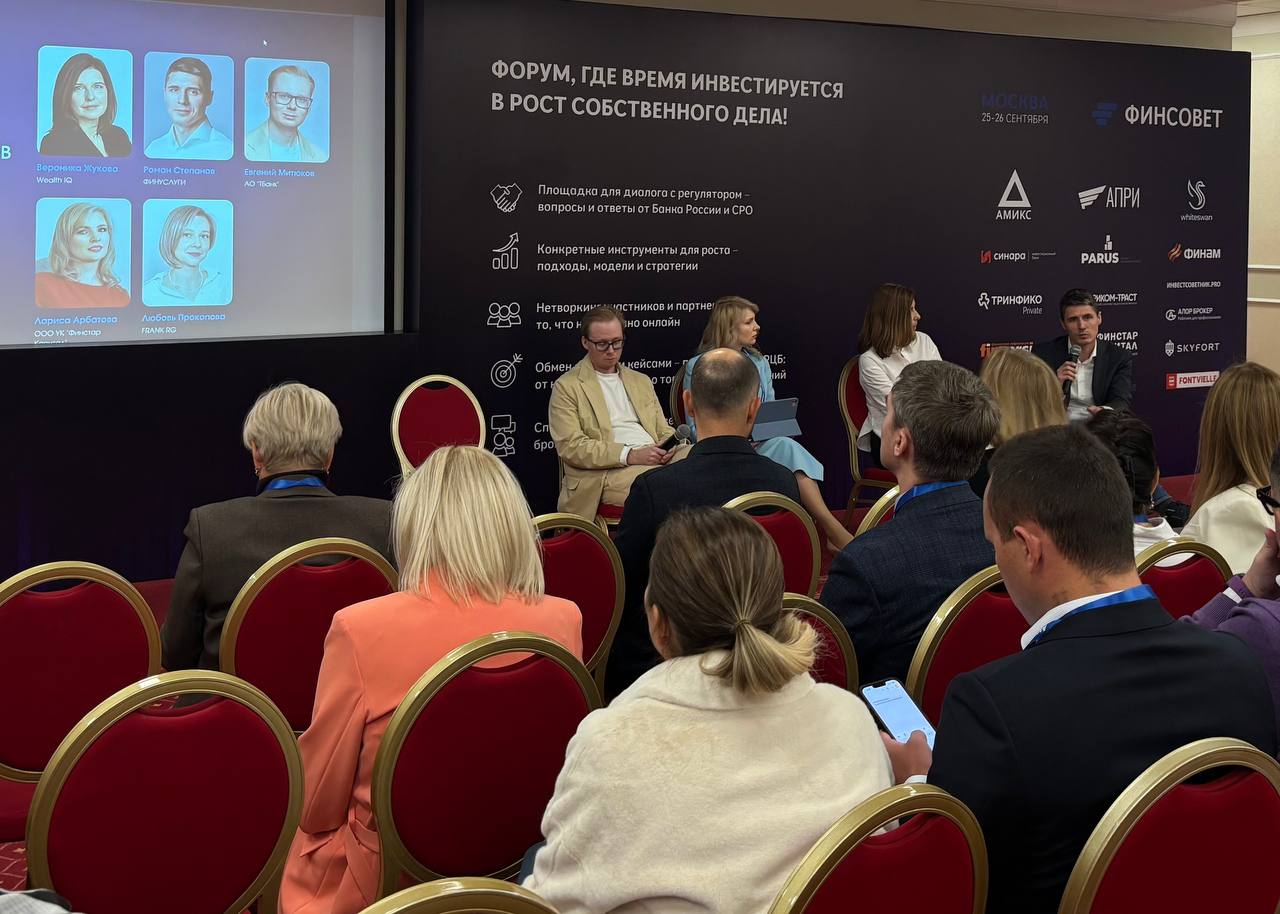
This was one of the topics discussed at the FinSovet forum.
FinSovet is an annual forum organized by the professional financial community. At today’s conference, Wealth iQ Executive Director Veronika Zhukova moderated a session dedicated to changing investor preferences. We are sharing the key insights from the discussion participants — these are not direct quotes, but our summary.
Evgeny Mityukov, T-Bank — on conservatism and copy-trading strategies
Larisa Arbatova, Finstar Capital — on collective investment
Over the past ten years, collective investment has evolved from a niche segment into a mass market. The number of unitholders has grown from 1.4 million to 18.1 million people, assets in mutual funds have increased from RUB 2.4 trillion to RUB 19.5 trillion, and the number of funds has risen from 1,500 to more than 3,400.
Veronika Zhukova, Wealth iQ — on how clients benefit from investment advisory
Investment advisory helps clients regain control over their capital. Before an investment adviser is involved, the portfolios of many high-net-worth investors often look chaotic: either a single account with no diversification, or dozens of accounts across different banks; assets are bought randomly, without a clear system; and the portfolio is overloaded with structured products carrying high hidden margins.
Once an adviser is brought in, the structure becomes clearer: the number of accounts and assets is optimized, transactions acquire economic logic, and the number of “toxic” structured products is reduced two- to threefold.
This was one of the topics discussed at the FinSovet forum.
FinSovet is an annual forum organized by the professional financial community. At today’s conference, Wealth iQ Executive Director Veronika Zhukova moderated a session dedicated to changing investor preferences. We are sharing the key insights from the discussion participants — these are not direct quotes, but our summary.
Evgeny Mityukov, T-Bank — on conservatism and copy-trading strategies
- Investors became more cautious in 2024–2025, with a noticeable outflow from equities and a shift toward more conservative instruments. The statistics support this trend: the median investor earned around 14–16% per annum, while broader asset classes such as gold, money market funds and bonds delivered stronger results.
- In the mass market and premium segments, the average account size in copy-trading strategies has been gradually declining, while among private clients it has remained more stable. The likely reason is a more flexible approach to strategies, as well as lower fees.
Larisa Arbatova, Finstar Capital — on collective investment
Over the past ten years, collective investment has evolved from a niche segment into a mass market. The number of unitholders has grown from 1.4 million to 18.1 million people, assets in mutual funds have increased from RUB 2.4 trillion to RUB 19.5 trillion, and the number of funds has risen from 1,500 to more than 3,400.
Veronika Zhukova, Wealth iQ — on how clients benefit from investment advisory
Investment advisory helps clients regain control over their capital. Before an investment adviser is involved, the portfolios of many high-net-worth investors often look chaotic: either a single account with no diversification, or dozens of accounts across different banks; assets are bought randomly, without a clear system; and the portfolio is overloaded with structured products carrying high hidden margins.
Once an adviser is brought in, the structure becomes clearer: the number of accounts and assets is optimized, transactions acquire economic logic, and the number of “toxic” structured products is reduced two- to threefold.